
Dieser Artikel ist derzeit nur auf Englisch verfügbar.
Choosing a commercial floor scrubber comes down to one calculation: how much floor you must clean, and how many hours you have to clean it in. Everything else — brush width, tank size, battery, brand — follows from that number. This guide walks through the sizing formula, the nine specifications that genuinely change outcomes, a realistic total-cost calculation, and the compliance documents you should demand before signing a purchase order.
Quick answer: how to choose a commercial floor scrubber
- Size by shift window, not by floor area alone. Required productivity (m²/h) = cleanable floor area ÷ hours available. Then divide by 0.65 to convert a manufacturer's rated figure into a realistic one.
- Match the machine class to the area: hand-push up to ~1,500 m², walk-behind 1,500–4,000 m², traction-driven 2,500–6,000 m², compact ride-on 4,000–8,000 m², large ride-on 6,000–15,000 m².
- Squeegee width matters more than brush width for leaving a dry floor — it should always exceed the brush path.
- Check tank capacity against your fill points. Each refill-and-empty cycle costs 8–15 minutes; undersized tanks quietly destroy productivity.
- Insist on verifiable CE (EU) or UKCA (UK) documentation with certificate numbers and validity dates, not a logo on a brochure.
1. What is a commercial floor scrubber — and when does it pay for itself?
A commercial floor scrubber (also called an auto scrubber, scrubber-dryer or floor washer) applies cleaning solution, agitates it with a rotating brush or pad, and immediately recovers the dirty liquid with a vacuum squeegee — leaving the floor clean and dry in a single pass.
The economic case is a labour substitution, not a cleaning-quality upgrade. Manual mopping delivers roughly 300–500 m² per operator-hour and leaves a wet floor behind. A scrubber delivers 700–5,500 m² per hour depending on class, and leaves the floor dry enough to walk on immediately.
The crossover point where a machine clearly beats a mop is around 1,000 m² cleaned daily. Below that, a mop and bucket can still be rational. Above about 4,000 m² of open floor, the labour saved by a ride-on machine typically exceeds the cost of the machine itself within the first year.
2. How do you size a floor scrubber to your floor area?
Use the shift window, not the total area, as your anchor — that is the mistake most buyers make. The formula:
Required real-world productivity (m²/h) = cleanable floor area (m²) ÷ available cleaning hours
Shortlist machines rated at: required productivity ÷ 0.6 to 0.7
The 0.6–0.7 factor is not pessimism; it is what aisles, turns, pallet legs, obstacles, refills and operator breaks actually cost. A machine rated at 3,600 m²/h does about 2,300–2,500 m²/h in a working warehouse.
| Cleanable floor area | Machine class | Typical rated productivity | ALTON model | Scrub path |
|---|---|---|---|---|
| Up to 1,500 m² | Compact hand-push | 1,000 m²/h | T2B | 330 mm |
| 1,000–2,500 m² | Walk-behind, compact | 1,500 m²/h | T3B | 430 mm |
| 1,500–4,000 m² | Walk-behind, wide path | 2,025 m²/h | T4B | 510 mm |
| 2,500–6,000 m² | Traction-driven walk-behind | 3,600 m²/h | T5BT | 560 mm |
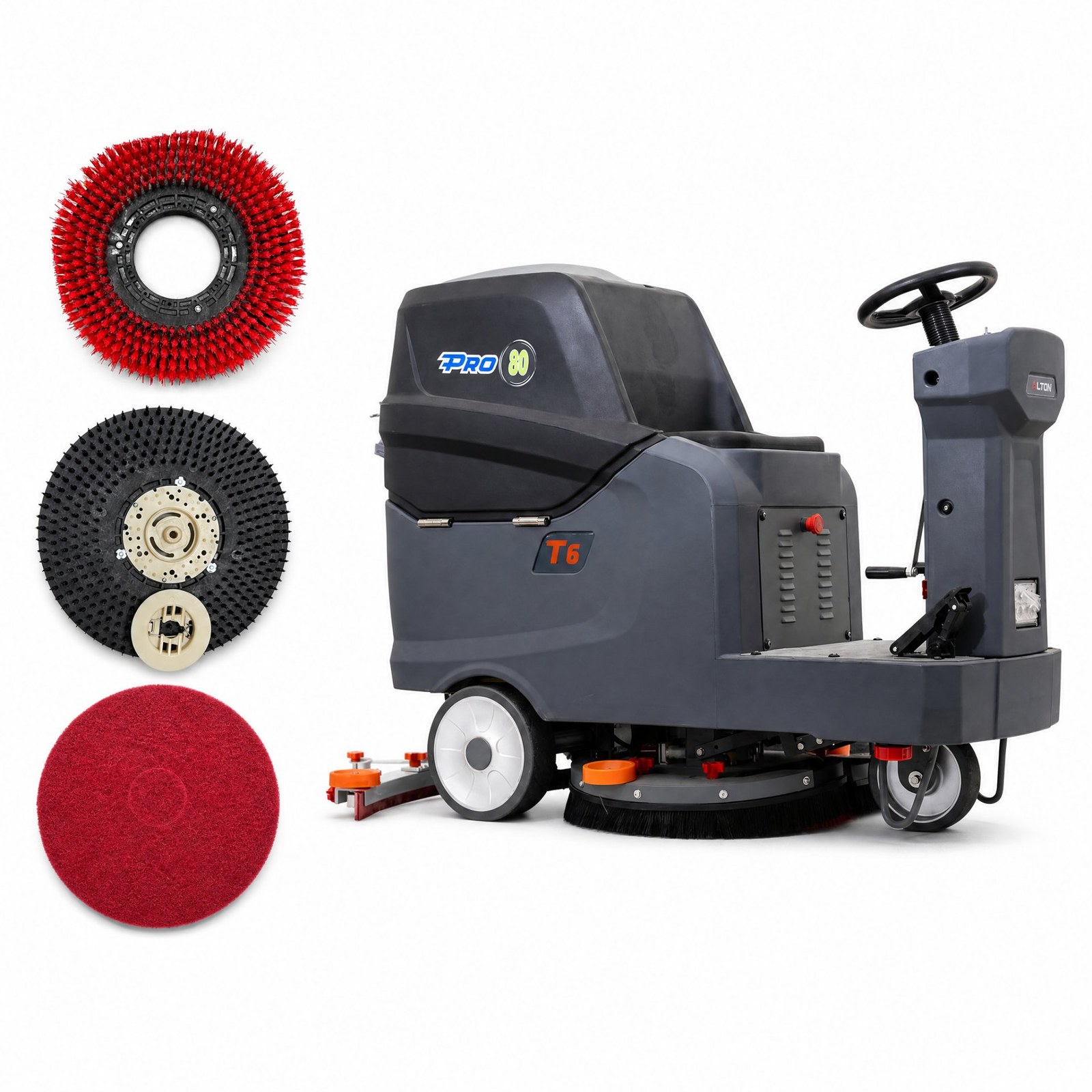
| 4,000–8,000 m² | Compact ride-on | 3,600 / 4,200 m²/h | T6R | 560 / 660 mm |
| 6,000–15,000 m² | Large ride-on | 5,525 m²/h | T8R | 850 mm |
Worked example. A 5,000 m² distribution centre must be cleaned inside a 2-hour window before the morning shift. Required productivity = 5,000 ÷ 2 = 2,500 m²/h real-world. Dividing by 0.65 gives a rated requirement of about 3,850 m²/h — so the T5BT (3,600 m²/h) is marginal and the T6R (4,200 m²/h in its 660 mm configuration) is the correct shortlist entry.
3. Hand-push, walk-behind with traction, or ride-on?
Three things decide the class: floor area, aisle geometry, and operator cost. The table below compares them on the axes that actually matter in a tender evaluation.
| Factor | Hand-push | Walk-behind (traction) | Ride-on |
|---|---|---|---|
| Best for | Small areas, tight aisles, retail | Mid-size sites, mixed layouts | Large open floors, warehouses |
| Scrub path | 330–510 mm | 560 mm | 560–850 mm |
| Realistic productivity | 650–1,400 m²/h | 2,200–2,400 m²/h | 2,300–3,600 m²/h |
| Operator fatigue | High over long shifts | Low — powered drive | Lowest |
| Turning / manoeuvrability | Excellent | Good | Needs open space |
| Purchase cost | Lowest | Mid | Highest |
| Cost per m² cleaned | Lowest below 1,500 m² | Lowest 2,500–6,000 m² | Lowest above 4,000 m² |
A detail buyers overlook: a traction-driven walk-behind often outperforms a ride-on in congested sites. The ALTON T5BT carries 60 L solution / 65 L recovery and a 300 W drive motor at 95 kg net — it fits where a 1,350 mm-long ride-on cannot turn, while still scrubbing 560 mm per pass.
4. Which specifications actually matter?
Nine numbers on a spec sheet change real-world outcomes. The rest is decoration.
| Specification | Why it matters | How to choose |
|---|---|---|
| Brush / pad width | Sets how much floor each pass covers | Match to aisle width; wider is faster but needs more open space |
| Squeegee width | Determines whether the floor dries — the #1 cause of slip complaints | Must exceed brush width (e.g. T4B: 510 mm brush, 830 mm squeegee) |
| Solution tank | Refill frequency; each cycle costs 8–15 min | ≥ 1 L per 40 m² of floor per pass, minimum |
| Recovery tank | Must hold dirty water plus foam headroom | Should be ≥ solution tank capacity |
| Brush pressure | Removes packed-on soiling; too much damages soft floors | 18–30 kg for sealed surfaces; 40–55 kg for raw concrete |
| Vacuum motor power | Drying performance | 300 W minimum; 500 W+ for ride-on and textured floors |
| Battery capacity & runtime | Must cover the longest shift without recharge | Rated runtime ≥ cleaning window × 1.3 |
| Sound level | Decides whether daytime cleaning is possible | 68–74 dB(A) is standard; <70 dB(A) for occupied buildings |
| Max climbing angle | Ramps, docks and loading bays | ≥10% for warehouses; 16–18% for multi-level parking |
5. How do floor type and soiling change the choice?
Floor material determines the brush, not the machine. Match them like this:
- Polished or sealed concrete — soft nylon brush or white/red pad, moderate pressure. Hard brushes glaze and dull the surface.
- Epoxy and resin coatings — soft pad, low pressure (18–20 kg). Aggressive brushes scratch the coating and void some flooring warranties.
- Ceramic tile and grout — medium brush, slightly higher pressure to reach grout lines. Avoid pressures that erode grout over time.
- Anti-slip / textured safety flooring — higher brush pressure and a strong vacuum motor; texture holds both dirt and water.
- Oil and grease (food plants, workshops, machine shops) — high brush pressure plus a degreasing detergent. Consider a machine with a large recovery tank, because heavily soiled floors consume solution faster.
- Fine dust (logistics, cement, packaging) — prioritise vacuum motor power and filter maintenance access over brush pressure.
For regulated environments, one more variable: antibacterial performance. In healthcare, food processing and pharmaceutical facilities, ask whether the machine's surfaces and brushes have been tested to a recognised standard. ALTON's scrubber components carry a TÜV SÜD antibacterial test report to ISO 22196:2011 showing antibacterial activity above 99.9% — the report is published with our downloadable certificates.
6. Battery, runtime and shift planning
Battery specification is where tenders are most often under-specified. Three rules:
- Rated runtime must exceed the cleaning window by at least 30%. Batteries lose capacity with age; a 3.5-hour rating today becomes 2.8 hours in year two.
- Check the charging window, not just the runtime. Lead-acid packs need 8–10 hours including cool-down, so a single battery set cannot serve two shifts without a swap.
- Lead-acid or lithium depends on shift count, not budget alone. Lead-acid is cheaper and proven; lithium charges in 2–3 hours, tolerates opportunity charging and needs no water top-ups — decisive for multi-shift sites.
| Model | Battery | Rated runtime | Sound level | Net weight |
|---|---|---|---|---|
| T2B | 2 × 12 V 45 Ah | 2.5 h | 68 dB(A) | 45 kg |
| T3B | 2 × 12 V 85 Ah | 1–2 h | — | 50 kg |
| T4B | 2 × 12 V 100 Ah | 3.5 h | 70 dB(A) | 65 kg |
| T5BT | 2 × 12 V 100 Ah | 3.5 h | 72 dB(A) | 95 kg |
| T6R | 2 × 12 V 100 Ah | 3.0 h | 73 dB(A) | 130 / 140 kg |
| T8R | 4 × 6 V 200 Ah | 4.0 h | 74 dB(A) | 170 kg |
7. What does it cost, and how fast does it pay back?
Purchase price varies with configuration, battery type and order volume, so the useful number is not the price — it is the labour hours removed per year. Here is the calculation for a typical mid-size site.
| Method | Effective rate | Hours per clean | Hours per year |
|---|---|---|---|
| Manual mopping (1 operator) | 400 m²/h | 12.5 h | 3,125 h |
| Two operators mopping | 800 m²/h combined | 6.3 h | 1,563 h |
| ALTON T6R ride-on (70% factor) | ~2,500 m²/h | 2.0 h | 500 h |
That is a saving of roughly 1,050 to 2,625 operator-hours per year from a single machine. At any Western European or North American labour rate, the annualised cost of the machine is a fraction of that number — which is why payback on ride-on units in daily-use sites is typically measured in months, not years.
Two costs buyers forget to include: consumables (squeegee blades every 3–6 months, brushes every 6–12 months) and battery replacement every 3–4 years for lead-acid. Budget 2–4% of purchase price per year for consumables and service.
8. Which certifications should you require from a supplier?
Marking on a brochure is not compliance. Ask for the certificate number, the issuing body and the validity dates, then verify them:
- CE marking (European Union) — supported by test reports for the Low Voltage Directive and EMC Directive, plus a Machinery Directive conformity assessment.
- UKCA marking (Great Britain) — required for machines placed on the GB market.
- ISO 9001 — evidence the factory runs a documented, audited quality management system.
- RoHS — restricted-substance compliance for electrical and electronic components.
- Antibacterial test reports (ISO 22196) — relevant for healthcare, food and pharmaceutical sites.
ALTON publishes downloadable originals — CE certificates for floor scrubbers, wet and dry vacuum cleaners and dry-ice machines, UKCA, ISO 9001:2015 and RoHS — all downloadable from the certificates section of our company page, alongside the ISO 9001:2015 quality-system certificate. See the same page for factory capability and inspection detail.
9. Seven mistakes that cost buyers money
- Buying to rated m²/h without a real-world factor. Apply 60–70%.
- Ignoring squeegee width. A narrow squeegee leaves streaks and a wet floor regardless of how well the brush cleaned.
- Undersizing the tanks. Every extra refill-and-empty cycle costs 8–15 minutes of paid time.
- Measuring total floor area instead of cleanable area. Racking, machinery and pallets typically remove 20–40% of the footprint.
- Choosing a ride-on for a congested site. Manoeuvring time erases the width advantage.
- Skipping the climbing angle check on sites with ramps or dock levellers.
- Accepting "CE certified" without a certificate number. Verify the number with the issuing body.
10. When OEM / ODM is the better route
If you are a distributor, a cleaning-service group or a brand owner, buying standard machines off the shelf is rarely the optimal path. OEM gives you your own colour, logo, decals and private-label documentation; ODM goes further — tank capacity, brush configuration, control layout and even control software tailored to your market.
Typical parameters: branding-level OEM minimums in the range of 5–20 units, and 25–40 days production lead time after sample approval. ALTON runs both programmes — see the OEM / ODM process page for the step-by-step workflow.
Get a sizing recommendation for your site
Send us three numbers — cleanable floor area, floor material and your cleaning window — and we will tell you which model fits, with a productivity calculation you can check. No obligation.
Häufige Fragen
How do I know what size floor scrubber I need?
Divide your cleanable floor area by the number of hours available in your cleaning window. A 5,000 m² warehouse cleaned inside a 2-hour window needs a real-world productivity of about 2,500 m²/h. Apply a 60–70% factor to the manufacturer's theoretical m²/h figure — aisles, turns, obstacles and tank refills all cost time — so in this case you would shortlist machines rated at roughly 3,600–4,200 m²/h, such as the ALTON T5BT or T6R, rather than one rated at 2,500 m²/h.
What is the difference between a walk-behind and a ride-on floor scrubber?
A walk-behind scrubber is pushed by the operator and suits areas up to about 4,000 m² or sites with tight aisles and many obstacles. A ride-on scrubber carries the operator, scrubs a wider path (560–850 mm versus 330–560 mm) and cleans large open floors several times faster. The practical crossover point is around 4,000 m² of open floor area: below it a walk-behind is usually more economical, above it a ride-on cuts labour hours enough to justify the higher purchase price.
How many square metres per hour can a floor scrubber clean?
Published productivity ranges from about 1,000 m²/h for a compact hand-push unit with a 330 mm brush to roughly 5,500 m²/h for a large ride-on machine with an 850 mm brush. In daily operation expect 60–70% of that figure. ALTON's range spans 1,000 m²/h (T2B) through 1,500 m²/h (T3B), 2,025 m²/h (T4B), 3,600 m²/h (T5BT and T6R) to 5,525 m²/h (T8R).
Can a floor scrubber be used on epoxy, ceramic tile and polished concrete?
Yes — all three are standard scrubber surfaces. The variables are the brush or pad type and the brush pressure, not the machine. Use a soft pad or soft nylon brush on polished epoxy and polished concrete to avoid dulling the finish, and a harder nylon or polypropylene brush on raw or sealed concrete. On grouted ceramic tile, a slightly higher brush pressure helps clean the grout lines, but avoid excessive pressure that erodes the grout.
Should I choose a lead-acid or a lithium battery?
Lead-acid batteries cost less upfront and are proven in daily commercial use, but they need regular water top-ups, must be charged in a ventilated area and dislike partial charging. Lithium packs cost roughly two to three times more, charge in 2–3 hours, tolerate opportunity charging during breaks and need no maintenance — which matters if you run two or three shifts a day. For single-shift operations on a tight budget, lead-acid remains the rational choice; for multi-shift or 24/7 sites, lithium usually pays back within two years.
How noisy are commercial floor scrubbers, and can they run during business hours?
Most commercial scrubbers run at 68–74 dB(A), similar to a busy office or a vacuum cleaner. ALTON machines measure 68 dB(A) (T2B) to 74 dB(A) (T8R). That is quiet enough for daytime cleaning in warehouses and factories, but for noise-sensitive environments such as hospitals, hotels and retail floors during trading hours, plan cleaning outside peak times or pick the lowest-decibel model that still meets your productivity target.
What certifications should a floor scrubber have for the EU and UK markets?
For the European Union, ask for a CE declaration backed by test reports for the Low Voltage Directive and EMC Directive, plus a Machinery Directive conformity assessment. For Great Britain, ask for UKCA marking. ISO 9001 certification tells you the factory runs a documented quality system, and RoHS confirms restricted-substance compliance. Always ask for the certificate number and validity dates and verify them with the issuing body — ALTON publishes downloadable CE, UKCA, ISO 9001 and RoHS certificates on its certifications page.
How often does a floor scrubber need maintenance?
Daily: empty and rinse the recovery tank, check the squeegee blades for wear and clean the vacuum filter. Weekly: inspect brush wear, check battery electrolyte levels on lead-acid packs and clean the tank sensors. Squeegee blades and brushes are consumables — expect to replace blades every 3–6 months and brushes every 6–12 months depending on hours and surface roughness. Budget roughly 2–4% of the machine's purchase price per year in consumables and service.
Can I get a floor scrubber with my own brand and colour?
Yes. Most manufacturers serving export markets, including ALTON, offer OEM and ODM programmes: your logo and colour scheme, custom decals, private-label manuals and packaging, and in ODM cases changes to tank capacity, brush configuration or control layout. Typical minimum order quantities start in the range of 5–20 units for branding-only OEM, and higher for tooling-level ODM changes. Lead times are usually 25–40 days after sample approval.
Is a floor scrubber worth it for a 1,000 m² facility?
Usually yes, if the floor is cleaned daily. Manually mopping 1,000 m² takes roughly 2.5 operator-hours; a compact machine such as the ALTON T2B (1,000 m²/h rated, about 700 m²/h realistic) does it in about 1.4 hours including fill and empty time, while leaving the floor dry enough to walk on immediately. The labour saving is modest per day but compounds to several hundred hours a year, and the slip-risk reduction from a dry floor is often the stronger argument.