
Este artículo está disponible actualmente solo en inglés.
Walk-behind or ride-on? For most facilities the answer is not about the machine — it is about three numbers you already have: your cleanable floor area, your cleaning window, and the width of your narrowest aisle. This guide gives you the decision rule, a productivity formula you can run in two minutes, a three-year cost comparison, and the ALTON model that fits each site size.
Quick answer: walk-behind or ride-on?
- Under ~4,000 m² of cleanable floor: walk-behind. A traction-driven model such as the T5BT covers the area inside a normal shift and costs far less to buy and run.
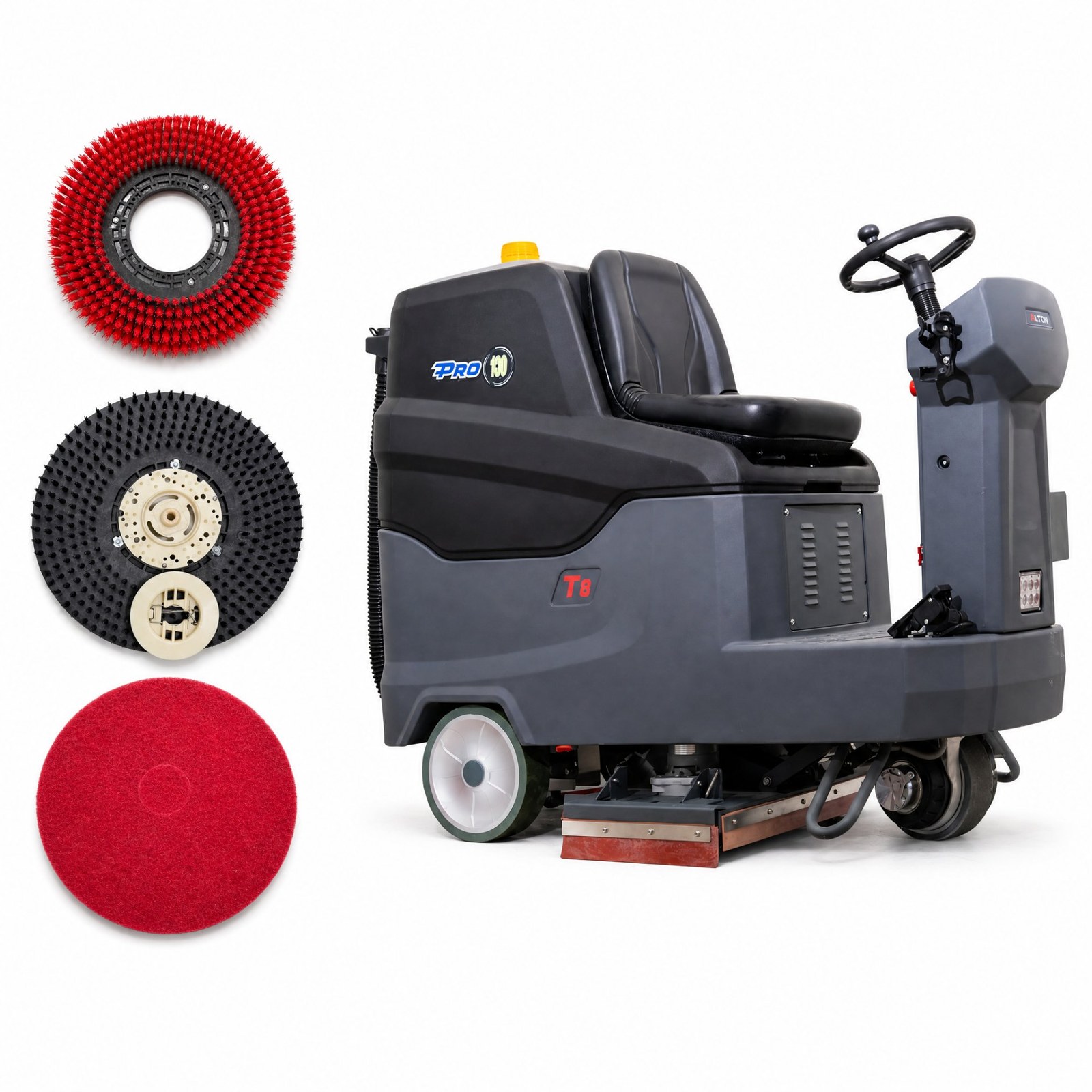
- Above ~6,000 m², or a tight cleaning window: ride-on. Operator time, not machine speed, is what you are buying — the T8R cleans roughly 1.5× the area of a T5BT per hour.
- Between the two: check the aisle test first. If your narrowest working aisle cannot give a ride-on room to turn, its width advantage never materialises.
- Size by hours, not by area. Required productivity (m²/h) = cleanable area ÷ hours available ÷ 0.65.
- Still unsure? Run both. A mixed fleet — one compact ride-on for the open hall, one walk-behind for corridors and loading bays — is what most sites above 8,000 m² end up with.
1. The decision in one table
| Cleanable floor area | Recommended class | Why | ALTON model |
|---|---|---|---|
| Up to 1,500 m² | Hand-push / compact walk-behind | Narrow paths, frequent obstacles, limited storage | T2B (330 mm) |
| 1,500 – 3,000 m² | Walk-behind | Still fits through standard doors; low capital cost | T3B (430 mm) |
| 2,500 – 4,000 m² | Walk-behind, wide path | More width without the ride-on footprint | T4B (510 mm) |
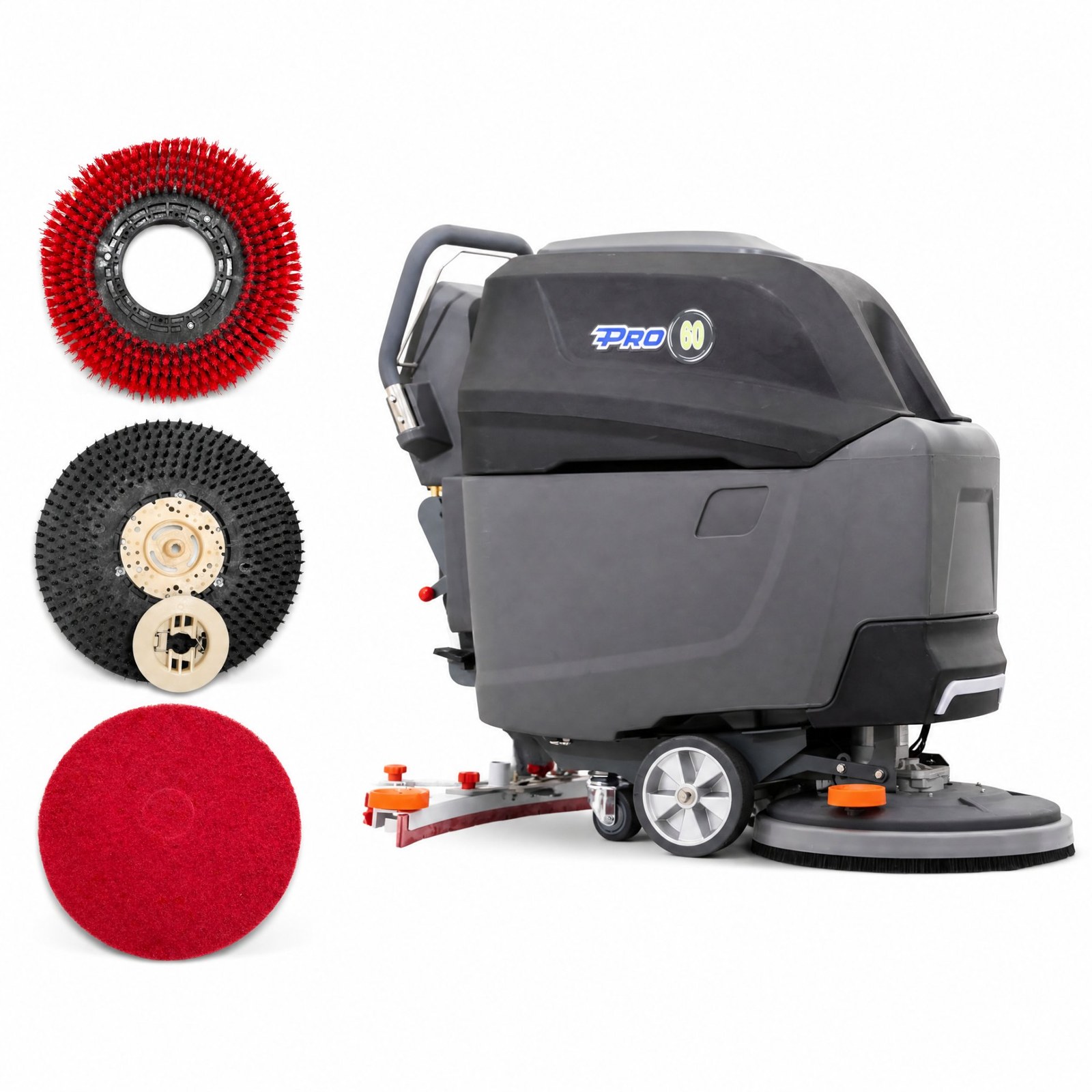
| 3,000 – 6,000 m² | Traction-driven walk-behind | Powered drive removes operator fatigue, handles ramps | T5BT (560 mm) |
| 4,000 – 9,000 m² | Compact ride-on | Operator seated, one pass covers a wide aisle | T6R (560 / 660 mm) |
| 6,000 – 15,000 m² | Large ride-on | Shift-window economics dominate every other factor | T8R (850 mm) |
The bands overlap on purpose. A 5,000 m² site with wide aisles and a three-hour window is a comfortable ride-on job; the same 5,000 m² broken into twelve rooms and a mezzanine is a walk-behind job. Area alone never decides it — which is why the next two sections matter more than the table.
2. Size the machine to your shift window
Buyers usually start with floor area. Start instead with the hours you actually have. A night shift that must finish by 06:00, a retail floor that opens at 09:00, a hospital corridor that can never be closed for long — these windows, not the square metres, set the machine size.
Required productivity (m²/h) = cleanable floor area ÷ hours available in the window
Realistic productivity = manufacturer's rated m²/h × 0.65
Choose the smallest class whose realistic figure is ≥ your required figure.
The 0.65 factor is not a fudge. A scrubber's rated throughput assumes a straight, unobstructed run at constant speed. Real floors have crossings, turns, pallets, pillars, door thresholds, and tank stops. Published figures are useful for comparing machines to each other; they are not a shift plan. We use the same factor in the commercial floor scrubber buying guide, so the two articles stay consistent.
Worked example
A 5,000 m² warehouse, cleaned overnight in a 2.5-hour window, on a team that also empties bins and spot-cleans — call it 2.0 hours of actual scrubbing.
- Required productivity: 5,000 ÷ 2.0 = 2,500 m²/h
- T5BT traction scrubber: 3,600 rated → 2,340 m²/h realistic. Close, but slightly short; the shift runs about 10 minutes over.
- T8R ride-on: 5,525 rated → 3,591 m²/h realistic. The floor is finished in roughly 1.4 hours, with 35 minutes of slack.
If that 35 minutes is genuinely spare — the operator goes on to other duties — the ride-on buys you real money. If the operator is paid for the full shift regardless, the saving is comfort and consistency, not cash. Be honest about which one applies before you spend it.
3. The aisle test nobody runs
Ride-on productivity assumes the machine keeps moving. In a congested layout it does not: every three-point turn, every wait for a forklift, every tight squeeze past racking costs the width advantage back. Before you look at ride-on pricing, walk your site with a tape.
- Find the narrowest aisle you must scrub end to end. Not the main run — the awkward one at the back.
- Add clearance. A walk-behind needs roughly its own scrub path plus 300 mm of working clearance. A ride-on needs enough width to complete a turn, so treat anything under about 1.5–2 m as walk-behind territory unless the manufacturer's turning radius says otherwise.
- Count the crossings. More than one obstruction per 30 m of run usually means a ride-on spends much of its shift slowing down.
- Check doors, lifts and gradients. Multi-floor sites with small lifts often cannot take a ride-on at all; a 95 kg traction walk-behind goes where a 170 kg ride-on cannot.
4. What the money actually looks like
Purchase price is the visible cost. Operator hours are the one that compounds. Using the 5,000 m² example above, at 250 working days a year:
| Line item | T5BT walk-behind (traction) | T8R ride-on |
|---|---|---|
| Realistic productivity | 2,340 m²/h | 3,591 m²/h |
| Time per clean | 2.14 h | 1.39 h |
| Operator hours per year | 535 h | 348 h |
| Operator hours over 3 years | 1,605 h | 1,043 h |
| Hours saved over 3 years | ≈ 562 h | |
At an €18/hour fully loaded labour rate, those 562 hours are roughly €10,100 of operator time. So the practical question is narrow: is the price gap between the two machines larger or smaller than €10,100? If a ride-on costs €5,000–€8,000 more, the labour saving repays it in roughly 18–30 months — and keeps paying for the rest of the machine's life. If your operator is on a fixed shift and the saved time is not redeployed, that repayment never happens and the walk-behind is the better buy.
Run the same arithmetic with your own labour rate and operating days. It takes five minutes and it settles more arguments than any brochure.
5. Where walk-behind still wins
- Congested or compartmentalised layouts. Retail back-of-house, schools, hospitals, laboratories — anywhere the machine stops and starts constantly.
- Multi-floor sites. Weight and lift dimensions rule out ride-ons long before productivity does.
- Mixed duties. A walk-behind can be loaded into a van and moved between sites; a ride-on generally needs a trailer.
- Tight capital budgets. A T3B or T4B gets a professional result for a fraction of ride-on capital, with simpler service and cheaper wear parts.
- Detail work. Edge scrubbing, washrooms, cafeterias, changing rooms — a ride-on is the wrong tool in all of them.
6. Where ride-on wins, and wins clearly
- Large open floorplates. Distribution centres, manufacturing halls, airport and transit concourses, big-box retail.
- Short cleaning windows. When the floor must be dry before a shift starts, hours saved are the whole point.
- Operator retention. Seated operation over a 4–6 hour shift is a materially different job from walking the same distance. Sites with high turnover often find the ride-on pays for itself in recruitment alone.
- Tank economics. The T8R carries 130 L of solution and 150 L of recovery. Every refill-and-empty cycle costs 8–15 minutes of paid time, and a large tank removes several of them per shift.
- Consistency. Constant travel speed gives a more uniform result across a long shift than a walking operator late in their route.
7. The ALTON range, side by side
| Model | Class | Brush / squeegee | Tanks (sol./rec.) | Rated output | Battery | Net weight |
|---|---|---|---|---|---|---|
| T2B | Hand-push | 330 / 420 mm | 18 / 20 L | 1,000 m²/h | 2×12V 45 Ah | 45 kg |
| T3B | Walk-behind | 430 / 650 mm | 32 / 38 L | 1,500 m²/h | 2×12V 85 Ah | 50 kg |
| T4B | Hand-push, wide | 510 / 830 mm | 40 / 50 L | 2,025 m²/h | 2×12V 100 Ah | 65 kg |
| T5BT | Traction walk-behind | 560 / 830 mm | 60 / 65 L | 3,600 m²/h | 2×12V 100 Ah | 95 kg |
| T6R | Compact ride-on | 560 / 660 mm | 85 / 95 L | 3,600 / 4,200 m²/h | 2×12V 100 Ah | 130–140 kg |
| T8R | Large ride-on | 850 / 1,000 mm | 130 / 150 L | 5,525 m²/h | 4×6V 200 Ah | 170 kg |
Two things worth noticing. First, the T5BT and the T6R share a 560 mm brush path and a similar rated output — the difference is whether the operator walks or sits, and how much solution they can carry before stopping. Second, squeegee width always exceeds brush width across the range; that is deliberate, because the squeegee is what decides whether the floor is left dry. For the full specification breakdown and the nine specs that matter, see the buying guide, or browse the complete floor scrubber range.
8. Five real sites, five answers
| Site | Area | Constraint | Recommendation | Reason |
|---|---|---|---|---|
| Urban retail store | 1,200 m² | Narrow aisles, opens 09:00 | T2B | 330 mm path threads fixtures; 45 kg is easy to store and move |
| Primary school | 3,000 m² | Corridors, classrooms, one cleaner | T3B | Quiet, compact, fits doorways; 650 mm squeegee leaves floors dry fast |
| Regional warehouse | 5,000 m² | 2.5 h night window, wide aisles | T5BT or T6R | Both meet the window; choose on labour cost and operator preference |
| Logistics hub | 9,000 m² | Two shifts, agency labour | T6R | Compact ride-on with 95 L recovery — fewer stops, less fatigue |
| Distribution centre | 14,000 m² | Fixed handover time, dry floor mandatory | T8R | 3,591 m²/h realistic; 150 L recovery tank keeps it moving |
| Mixed site, 8,000 m² | 8,000 m² | Open hall + narrow bays + loading dock | Fleet: T8R + T4B | One machine cannot be both wide and narrow; two can |
9. Don't skip the compliance check
Whichever class you choose, the machine has to be legal to sell and to operate in your market. Ask for originals, not screenshots, and check that the certificate number is verifiable with the issuing body:
- CE marking (EU) — machinery safety, plus the applicable low-voltage and EMC directives.
- UKCA marking (Great Britain) — required for machines placed on the GB market.
- ISO 9001 — evidence the factory runs an audited quality management system.
- RoHS — restricted-substance compliance for electrical and electronic components.
- Antibacterial test reports (ISO 22196) — relevant for healthcare, food and pharmaceutical environments.
ALTON publishes downloadable originals — CE certificates for floor scrubbers, wet and dry vacuum cleaners and dry-ice machines, UKCA, ISO 9001:2015 and RoHS — all available from the certificates section of our company page. Buying for resale under your own brand? The OEM / ODM process page covers colour, logo, private-label documentation and the lead times involved.
10. Six questions to settle before you sign
- What is my cleanable area — not my total area? Racking, machinery and pallets typically remove 20–40% of the footprint.
- How many hours can the floor actually be out of service? Put a number on it, not a preference.
- What is my narrowest working aisle? Measured, not estimated.
- Are there ramps or dock levellers? Check the machine's rated climbing angle; traction-driven models handle gradients far better than push units.
- Will the saved operator time be redeployed? If not, labour savings are theoretical.
- Where does the machine live overnight? Charging point, drain point, and whether it fits through the door it has to pass.
Tell us your floor, get a straight answer
Send three numbers — cleanable floor area, floor material and your cleaning window — and we will tell you whether walk-behind or ride-on fits, with the productivity calculation shown so you can check it. No obligation, no pressure.
Preguntas frecuentes
Is a ride-on floor scrubber always faster than a walk-behind?
Only where it can keep moving. The ALTON T8R is rated at 5,525 m²/h against the T5BT's 3,600 m²/h, so on open floorplate it is about 1.5× faster. In a compartmentalised layout with frequent turns, obstacles and doorways, that advantage erodes — much of the shift is spent slowing, turning and waiting. Run the aisle test before assuming the bigger machine is the faster one.
What floor area justifies buying a ride-on scrubber?
As a working threshold, above roughly 6,000 m² of cleanable floor a ride-on usually pays for itself in operator time, and above 9,000 m² it is rarely a close call. Between 4,000 and 6,000 m² the decision depends on aisle width and cleaning window rather than area. Below 4,000 m² a walk-behind — hand-push or traction-driven — is normally the better buy.
Can one ride-on replace two walk-behind machines?
Sometimes, but not on every site. A ride-on replaces the open-area work of two walk-behinds, yet it cannot do the detail work — washrooms, edges, cafeterias, narrow bays — that the second machine was really there for. Most sites above 8,000 m² end up with a mixed fleet: one ride-on for the hall and one walk-behind for everything else.
How much operator time does a ride-on actually save?
On a 5,000 m² floor the arithmetic is: T5BT at 3,600 rated × 0.65 = 2,340 m²/h realistic, so 2.14 hours per clean; T8R at 5,525 rated × 0.65 = 3,591 m²/h realistic, so 1.39 hours. That is roughly 0.75 hours a day, about 187 hours a year at 250 operating days — around €10,100 of operator time over three years at an €18/hour loaded rate. Whether that becomes money depends on whether the saved time is genuinely redeployed.
Do ride-on scrubbers require a licence or special training?
No licence is required. Operators do need a short induction — controls, emergency stop, battery charging, tank handling and the site's own safety rules — typically an hour or two. Seated operation over a long shift is less physically demanding than walking, which is one reason sites with high labour turnover find ride-ons easier to staff.
Will a ride-on fit through my aisles and doorways?
Measure before you buy. A walk-behind needs roughly its own scrub path plus 300 mm of working clearance; the T2B at 330 mm goes almost anywhere. A ride-on needs enough width to complete a turn, so treat anything under about 1.5–2 m as walk-behind territory unless the manufacturer's stated turning radius says otherwise. Also check lift dimensions and floor loading on multi-floor sites — a 95 kg T5BT travels where a 170 kg T8R cannot.
Which type is cheaper to maintain?
Walk-behind machines are cheaper to keep running: fewer wear parts, simpler drivetrain, lower-cost consumables and no traction motor on hand-push models. A ride-on adds drive system, steering and seating components, and larger batteries to replace — the T8R runs four 6V 200 Ah units, roughly double the battery capacity of a walk-behind. Budget battery replacement over a 3–5 year horizon for either class, not just brushes and squeegee blades.
Should I buy one machine for both a warehouse and a small retail area?
Only if the smaller area is genuinely small and open. A single machine sized for a warehouse is usually too wide for retail back-of-house, and a machine sized for the retail area will make the warehouse shift overrun. If both areas matter, two correctly sized machines beat one compromise every time — a T8R for the hall and a T4B for the congested zones costs less in operator hours than one machine doing both badly.
How do ramps and dock levellers affect the choice?
Check the machine's rated climbing angle against your steepest gradient before ordering. Hand-push units rely on operator effort on an incline, which is tiring and inconsistent; a traction-driven walk-behind such as the T5BT holds a constant speed up a ramp and is the usual answer for sites with docks, ramps or split-level floors. On ride-ons, confirm both the climbing angle and that recovery tank contents will not spill on the gradient.
Should I buy the smaller machine now and step up later?
Buy once if you can. Sizing for today's area and upgrading in 18 months means paying for two machines, and the undersized one sits idle or runs overtime in the meantime. If growth is genuinely uncertain, size to the confirmed area and choose a model with headroom in tank capacity and battery — the T5BT's 60/65 L tanks and 100 Ah battery give more slack than a compact unit's 18/20 L and 45 Ah, without committing you to ride-on capital.